David Bowie’s insane music career has spanned for over 5 decades, in which he has changed his style, personas and music genre more times than he has released albums. His revolutionary style, personality and voice has influenced so many artists since his journey began and even after it has ended.
.jpg)
Bowie started his career as David Jones, playing
with a number of different bands, even leading his own band called Davy Jones
and the Lower Third (with a few singles but nothing hugely
successful). However out of fear of being confused with The Monkeys own
Davy Jones he changed his last name to Bowie (inspired by the knife developed
by the 19th century American pioneer Jim Bowie). After this Bowie started
his own solo career in one of the most experimental times of his life (joining
a Buddhist monetary for a few weeks in 1967 and forming a mime troupe).
In 1969 (a year before his marriage to Angie Bowie)
Bowie returned to full time music, signing a deal with Mercury Records. By the
summer Bowie released his first top-five entry on the UK Singles
Chart; Space Oddity (which he said was influenced by Stanley
Kubrick's 2001: A Space Odyssey).
Space Oddity sparked interest with the general
public (greatly due to the BBC using the single during the coverage of the
Apollo 11 moon landing). After the released another 2 albums; The Man Who
Sold the World (1970) which further encapsulated Bowie in stardom with a
greater rock vibe than Bowie had even experimented with before, and Hunky
Dory (1971). After this Bowie introduced the world to Ziggy Stardust and The
Spiders from Mars.

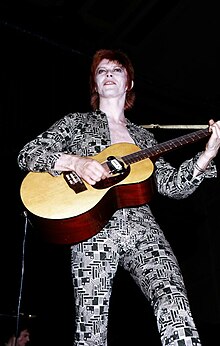
The Rise and Fall of Ziggy Stardust and the Spiders
from Mars (1972) along with his claims of being gay (in a time when it was
still an unspoken about topic) made Bowie a superstar. He became Ziggy and
would dress up in elaborate wild costumes when performing, seeing a new age of
rock music (being the end of the Woodstock era).
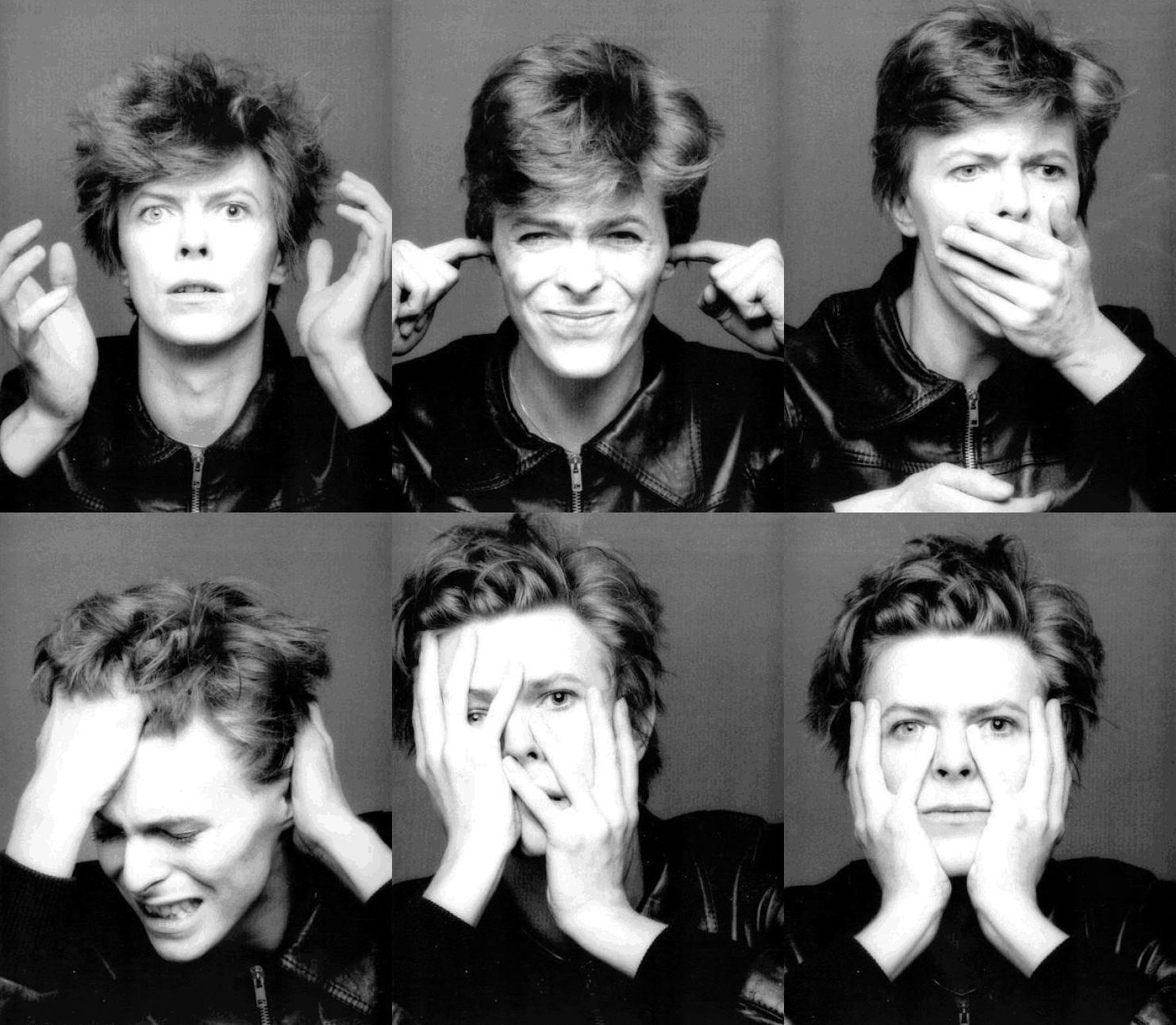
Just as quickly as Ziggy arrived Bowie changed, continuing with glam rock without the Ziggy persona with the album Aladdin Sane (1973) featuring his collaboration with Mick Jagger and Keith Richards, also in this time he produced albums for Lou Reed and Iggy Pop. He then showed his appreciation for the early Mod scene with his cover album Pin Ups.
:format(jpeg):mode_rgb():quality(90)/discogs-images/R-354906-1412775755-4012.jpeg.jpg)
Just as quickly as Ziggy arrived Bowie changed, continuing with glam rock without the Ziggy persona with the album Aladdin Sane (1973) featuring his collaboration with Mick Jagger and Keith Richards, also in this time he produced albums for Lou Reed and Iggy Pop. He then showed his appreciation for the early Mod scene with his cover album Pin Ups.
By the mid 70’s Bowie dropped the glam rock style
and released two albums David Live (1974) and Young Americans (1975).
In the Young Americans album Bowie releaser his first American number 1 single,
Fame, which was co-written with John Lennon and Carlos Alomar. In the
1980’s living in New York Bowie released Scary Monsters in which had the song
Ashes to Ashes in it, which was seen as a kind of update of Space Oddity, then
three years later recorded Lets Dance (1983).


Over the next decade Bowie
bounced from music and film, despite some modest hits and the much-hyped album
Black Tie White Noise (1993) (a wedding gift for his new wife Iman),
Bowies music career faltered. He kept a rather low profile until the release of
his album The Next Day (2013), which jumped to number 2 on
the Billboard charts. Then later following year, Bowie released a
greatest hits collection, Nothing Has Changed.



No comments:
Post a Comment